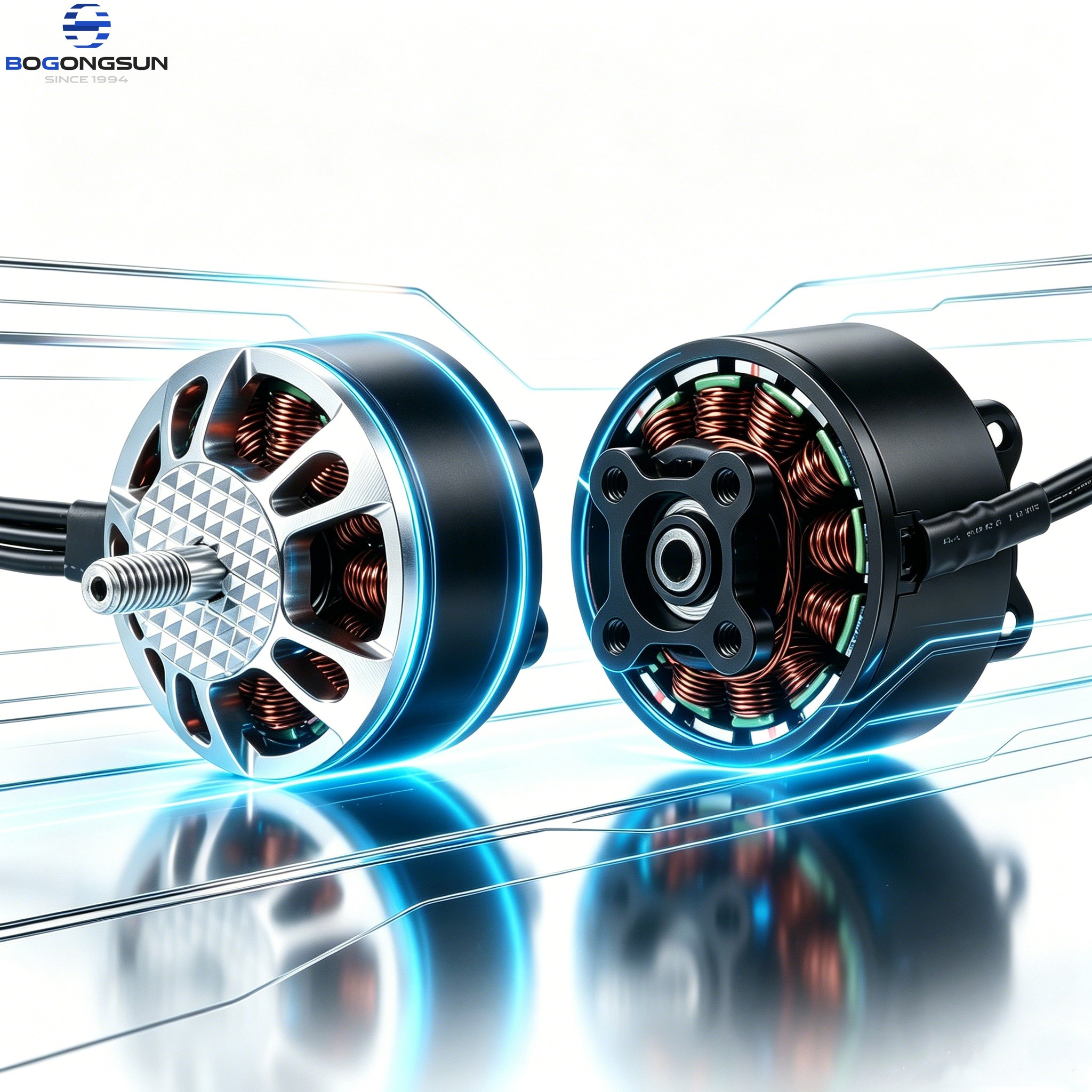
As the global drone industry continues to evolve, UAV technology is expanding far beyond recreational flying and aerial photography. Today, drones are widely used in agriculture, logistics, aerial mapping, industrial inspection, emergency rescue, military operations, and FPV racing. Behind every stable flight and every successful mission lies one critical component: the drone motor.
Drone motors are responsible for converting electrical energy into mechanical torque, generating the rotational force needed to drive propellers and create thrust. Whether it is a compact FPV racing drone or a large industrial heavy lift UAV, motor performance directly affects flight stability, maneuverability, payload capability, speed, and endurance.
In multirotor systems, drone motors create lift and directional control through differential thrust. By adjusting the rotational speed of individual motors, the aircraft can perform roll, pitch, yaw, hovering, and rapid directional changes. In fixed-wing UAVs, the motor primarily acts as the forward propulsion source, determining cruising efficiency and overall flight performance.
As UAV applications become increasingly specialized, different types of drone motors have emerged to meet varying operational requirements. From high-efficiency brushless motors to lightweight coreless motors, each motor architecture offers unique advantages for specific drone platforms and missions.
Drone motors operate based on electromagnetic interaction. Electrical current flows through the stator windings, creating a magnetic field that interacts with permanent magnets mounted on the rotor This interaction generates rotational movement, which then spins the propeller to produce thrust.The relationship between propeller speed and thrust can be simplified as:
T∝RPM2×D4
This means that both motor speed and propeller diameter significantly influence lifting force. Larger propellers can move more air efficiently, while higher RPM increases airflow velocity. Modern UAV propulsion systems must therefore carefully balance torque, speed, efficiency, and thermal performance.
Efficient motor systems are especially important in industrial drones because power consumption directly affects flight endurance and payload capacity. A poorly matched motor may generate excessive heat, waste battery power, or reduce overall flight stability.
Brushless DC motors, commonly known as BLDC motors, are currently the most widely used motors in the drone industry. Their high efficiency, long service life, and strong power output make them ideal for modern UAV applications.
Unlike traditional brushed motors, BLDC motors use electronic commutation instead of physical brushes. This design greatly reduces friction and wear, allowing the motor to operate more efficiently and reliably at high rotational speeds.
BLDC motors are commonly used in:
FPV racing drones
Agricultural UAVs
Heavy lift drones
Industrial inspection platforms
Professional aerial photography systems
One of the biggest advantages of brushless motors is their excellent power-to-weight ratio. They can produce strong torque while remaining relatively lightweight, which is essential for aircraft performance. In addition, BLDC motors respond quickly to throttle changes, enabling precise flight control and stable hovering.
Because of these advantages, brushless motors have become the dominant propulsion solution in both commercial and industrial UAV markets.
Permanent Magnet Synchronous Motors, or PMSM motors, are closely related to brushless motors but offer smoother and more precise operation. These motors typically use sinusoidal wave control, allowing quieter rotation and lower vibration levels during flight.
PMSM motors are increasingly used in:
Military UAVs
Professional surveying drones
High-end industrial inspection systems
Long-endurance UAV platforms
Compared with traditional BLDC systems, PMSM motors can achieve higher efficiency at stable operating speeds. Their smoother torque delivery also helps reduce vibration, which is especially important for drones carrying sensitive imaging or LiDAR equipment.
As industrial UAV technology advances, PMSM systems are becoming more popular in applications requiring precision, reliability, and low-noise operation.
Before brushless technology became mainstream, many small drones used brushed DC motors. These motors rely on physical brushes to transfer electrical current to the rotating components.
Brushed motors offer several advantages:
Simple structure
Low manufacturing cost
Easy control systems
Because of their affordability, they are still commonly found in:
Toy drones
Educational UAV kits
Entry-level mini drones
However, brushed motors also have major limitations. The physical brushes wear out over time, reducing lifespan and reliability. They also generate more heat and friction, leading to lower efficiency and reduced flight endurance.
For professional UAV applications, brushed motors have largely been replaced by brushless alternatives.
The structural design of a drone motor significantly affects its performance characteristics. Modern UAV motors are generally divided into two main categories: inrunner motors and outrunner motors.
Outrunner motors are the most common motor type used in multirotor drones. In this design, the outer shell rotates around the internal stator.
This structure provides several important benefits:
Higher torque output
Better compatibility with large propellers
Lower operating RPM
Improved efficiency for lifting applications
Outrunner motors are especially suitable for:
Agricultural drones
Heavy lift UAVs
Aerial photography drones
Industrial multirotor platforms
Their ability to generate strong torque at lower rotational speeds makes them ideal for carrying heavy payloads while maintaining stable flight.
Inrunner motors feature an internal rotating rotor surrounded by a stationary outer housing. This design allows much higher RPM operation compared with outrunner systems.
Inrunner motors are commonly used in:
Fixed-wing UAVs
EDF drones
High-speed aircraft
Specialized racing systems
Because they operate at extremely high rotational speeds, inrunner motors are often paired with gear systems or ducted fan designs.
Although they produce less torque than outrunner motors, their compact size and high-speed capability make them suitable for forward-propulsion applications.
Coreless motors are ultra-lightweight motors commonly used in nano drones and miniature UAV systems. Unlike traditional motors, they eliminate the iron core inside the rotor, reducing rotational inertia and improving acceleration response.
Coreless motors offer:
Extremely lightweight construction
Fast throttle response
Compact size
Low inertia
These motors are often used in:
Indoor drones
Micro UAVs
Educational mini drones
Lightweight surveillance systems
Although their power output is limited, coreless motors remain important for compact drone applications where low weight is critical.
Modern UAV motors consist of several key structural components that influence efficiency, durability, and performance.
The stator contains laminated steel cores and copper windings that generate electromagnetic fields. Rotor assemblies use permanent magnets to create rotational motion. High-quality bearings reduce friction and improve stability, while precision-balanced shafts help minimize vibration during operation.
Cooling systems are also essential. Industrial UAV motors often feature CNC aluminum housings and optimized airflow channels to improve heat dissipation. Effective thermal management helps prevent overheating and extends motor lifespan during continuous high-load operation.
Different drone applications require different motor characteristics.
FPV racing drones prioritize rapid acceleration and high RPM performance. These systems usually use high-KV brushless motors designed for aggressive maneuverability and quick throttle response.
Agricultural drones require high torque, long endurance, and waterproof protection because they often operate in harsh outdoor environments while carrying heavy spraying systems.
Heavy lift industrial drones rely on large low-KV motors capable of driving oversized propellers efficiently. These UAVs are used in logistics, construction, rescue operations, and industrial transportation.
Mapping and surveying drones require stable low-vibration motors to ensure accurate imaging and LiDAR data collection. Military UAVs, meanwhile, demand reliability, durability, and low-noise operation under extreme environmental conditions.
Several important parameters determine UAV motor performance.
KV represents the motor’s rotational speed per volt.
| Low KV Motors | High KV Motors |
|---|---|
| Higher torque | Higher speed |
| Larger propellers | Smaller propellers |
| Heavy lift UAVs | FPV drones |
Low-KV motors are typically used for industrial heavy lift systems, while high-KV motors are preferred for racing drones.
Motor thrust determines the aircraft’s lifting capability and payload capacity. Higher thrust allows drones to carry larger equipment and maintain stable flight under heavy loads.
Motor efficiency directly affects battery consumption and flight endurance. Efficient motors convert more electrical energy into useful mechanical power while reducing heat generation.
Heat management is critical in industrial UAV systems. Poor thermal performance may lead to efficiency loss, overheating, or even motor failure during long-duration flights.
Professional UAV motors undergo extensive testing to ensure safety and reliability.
Common testing procedures include:
Dynamometer thrust testing
RPM measurement
Thermal endurance testing
Vibration analysis
Waterproof testing
Dust resistance testing
Industrial drone motors may also comply with international certifications such as CE, FCC, and RoHS standards.
These testing processes help ensure stable operation in demanding industrial environments.
 what's app