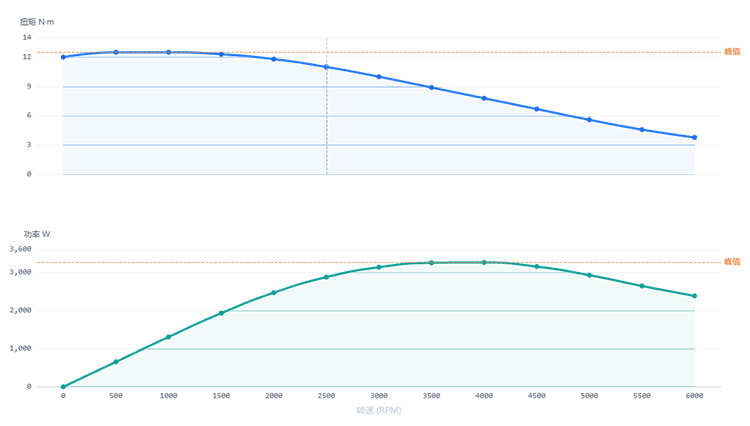
When selecting a UAV motor, peak power often attracts the most attention. A motor with a higher peak output may appear more powerful, but can it maintain that performance throughout an actual flight mission?
For UAV applications such as agricultural spraying, aerial surveying, logistics, and industrial inspection, motor performance is not determined by peak power alone. Continuous output, thermal stability, cooling conditions, and flight duty cycles all influence how reliably a motor performs.
Understanding the difference between peak and continuous output helps UAV manufacturers select motors that deliver not only strong thrust but also reliable long-duration performance.
Peak output refers to the maximum power or current a motor can deliver for a limited period without exceeding its permitted operating limits. It is typically used during short-duration events such as takeoff, rapid climbing, or sudden load increases.
Continuous output refers to the power a motor can maintain over an extended period while keeping its temperature within an acceptable operating range.
The difference is particularly important for UAV motors because a motor capable of producing high peak power does not necessarily have the thermal capacity to sustain that output.
For example, a drone motor may deliver strong thrust during takeoff but experience excessive temperature rise if it operates near its peak load throughout the mission.
| Performance Factor | Peak Output | Continuous Output |
|---|---|---|
| Operating duration | Short periods | Extended operation |
| Typical application | Takeoff and rapid climbing | Cruising and long-duration missions |
| Thermal condition | Temporary temperature rise | Stable temperature management |
| Main concern | Maximum thrust capability | Long-term thermal reliability |
For UAV motor selection, peak power indicates short-term capability, while continuous power indicates how well the motor supports the actual mission.
Motor temperature is one of the most important indicators when evaluating continuous output.
During operation, electrical losses in the windings and magnetic losses inside the motor generate heat. As the motor continues running, its temperature rises until heat generation and heat dissipation approach equilibrium.
This condition is known as thermal steady state.
Three temperature points are particularly important:
Winding Temperature: The temperature of the motor windings, which is closely related to insulation life and thermal limits.
Stator Temperature: Indicates heat accumulation in the stator structure and provides useful information about motor thermal behavior.
Motor Surface Temperature: Easier to measure during testing, but it may be significantly lower than the internal winding temperature.
A motor should not be considered suitable for continuous operation simply because its external surface temperature appears acceptable. Internal winding temperature and the insulation system must also be considered.
For UAV manufacturers, continuous output should be evaluated through a controlled thermal test, allowing the motor to operate until its temperature approaches a stable condition or reaches the defined test limit.
UAV motors experience different loads throughout a flight mission. Two common operating conditions are repeated climbing and steady cruising.
Repeated Climb
During climbing, the propulsion system requires increased thrust, causing higher motor current and additional heat generation. If the UAV repeatedly climbs, accelerates, and changes altitude, the motor may not have sufficient time to cool between high-load periods.
Even when each climb lasts only a short time, repeated high-current operation can gradually increase motor temperature.
Steady Cruise
During steady cruising, the motor generally operates at a more consistent load. Although the required output may be lower than during climbing, the motor must maintain this condition for an extended period.
This makes thermal balance, efficiency, and cooling performance particularly important.
| Operating Condition | Repeated Climb | Steady Cruise |
|---|---|---|
| Motor load | Frequently increases | Relatively stable |
| Current demand | High during climbing | More consistent |
| Temperature behavior | Repeated heating cycles | Gradual rise toward equilibrium |
| Main requirement | Short-term overload capability | Continuous thermal stability |
A UAV motor that performs well during a short thrust test may still struggle during a long-duration mission. Both operating conditions should therefore be included in motor validation.
Motor cooling is not determined by motor design alone. Propeller airflow and airframe layout also influence thermal performance.
Propwash refers to the airflow generated by a rotating propeller. In multirotor UAVs, this airflow can help remove heat from the motor during flight.
However, cooling performance varies depending on propeller diameter, motor position, installation clearance, and airflow direction.
Airframe airflow also matters. Motors installed close to arms, protective structures, or other components may experience different cooling conditions compared with motors operating in open airflow.
Several factors should be considered:
Propeller Size and Pitch: Influence airflow distribution and motor loading.
Motor Mounting Position: Determines how effectively air reaches the motor body.
Airframe Design: Arms, ducts, and protective structures may restrict airflow.
Flight Speed: Forward movement can change airflow around the propulsion system.
Ambient Temperature: Higher environmental temperatures reduce the available cooling margin.
For OEM testing, motor thermal performance should be evaluated under conditions that closely represent the actual UAV configuration rather than relying entirely on an open-bench test.
A current and temperature trace helps engineers understand how a UAV motor responds to changing loads over time.
The following is an illustrative example of a motor test under a controlled laboratory setup.
Example Test Conditions
Ambient temperature: 25°C
Propeller: 18 × 6.1 inch
Supply voltage: 22.2V nominal
Test configuration: Fixed test stand with controlled airflow
Operating profile: Repeated high-load climb simulation followed by lower-load cruise simulation
Temperature measurement: Motor housing surface sensor
Illustrative Test Data
| Time (min) | Current (A) | Surface Temp. (℃) | Operating Condition |
| 0 | 8 | 25 | Initial condition |
| 1 | 32 | 29 | High-load climb |
| 2 | 15 | 34 | Reduced-load operation |
| 3 | 32 | 39 | Repeated climb |
| 4 | 15 | 44 | Cruise simulation |
| 5 | 32 | 49 | Repeated climb |
| 6 | 15 | 54 | Cruise simulation |
| 8 | 15 | 60 | Steady lower-load operation |
Note: These values are illustrative only, not actual BG Motor test results or recommended operating limits. A real test requires model-specific motor parameters, calibrated instruments, and defined test conditions.
The data demonstrates two important points.
First, current increases significantly during high-load climbing, resulting in additional heat generation. Second, reducing current during cruising does not immediately reduce motor temperature because the motor requires time to dissipate accumulated heat.
Engineers should therefore monitor both current and temperature over the entire duty cycle rather than evaluating only the maximum current or peak thrust.
For a more complete assessment, winding temperature, voltage, RPM, thrust, and ESC temperature should also be recorded.
For OEM drone projects, a motor's continuous output should be evaluated according to the actual flight mission rather than a single power or thrust figure.
Before recommending a motor configuration, BG Motor considers several application parameters:
Aircraft Information: UAV type, takeoff weight, payload, and propulsion configuration.
Flight Requirements: Target flight duration, cruising speed, climbing rate, and maximum altitude.
Propulsion Setup: Propeller diameter, pitch, motor KV, ESC, and battery voltage.
Operating Conditions: Ambient temperature, airflow, and expected operating environment.
Duty Cycle: Duration of takeoff, climbing, cruising, hovering, descending, and landing phases.
With this information, BG Motor can help OEM customers evaluate motor power, thermal performance, propeller matching, and customization requirements.
A motor's peak output tells you how much power it can deliver for a short period. Its continuous output tells you how reliably it can support the entire mission.
For demanding UAV applications, the right motor is not simply the one with the highest peak power, but the one that maintains the required performance throughout the actual flight duty cycle.
 what's app