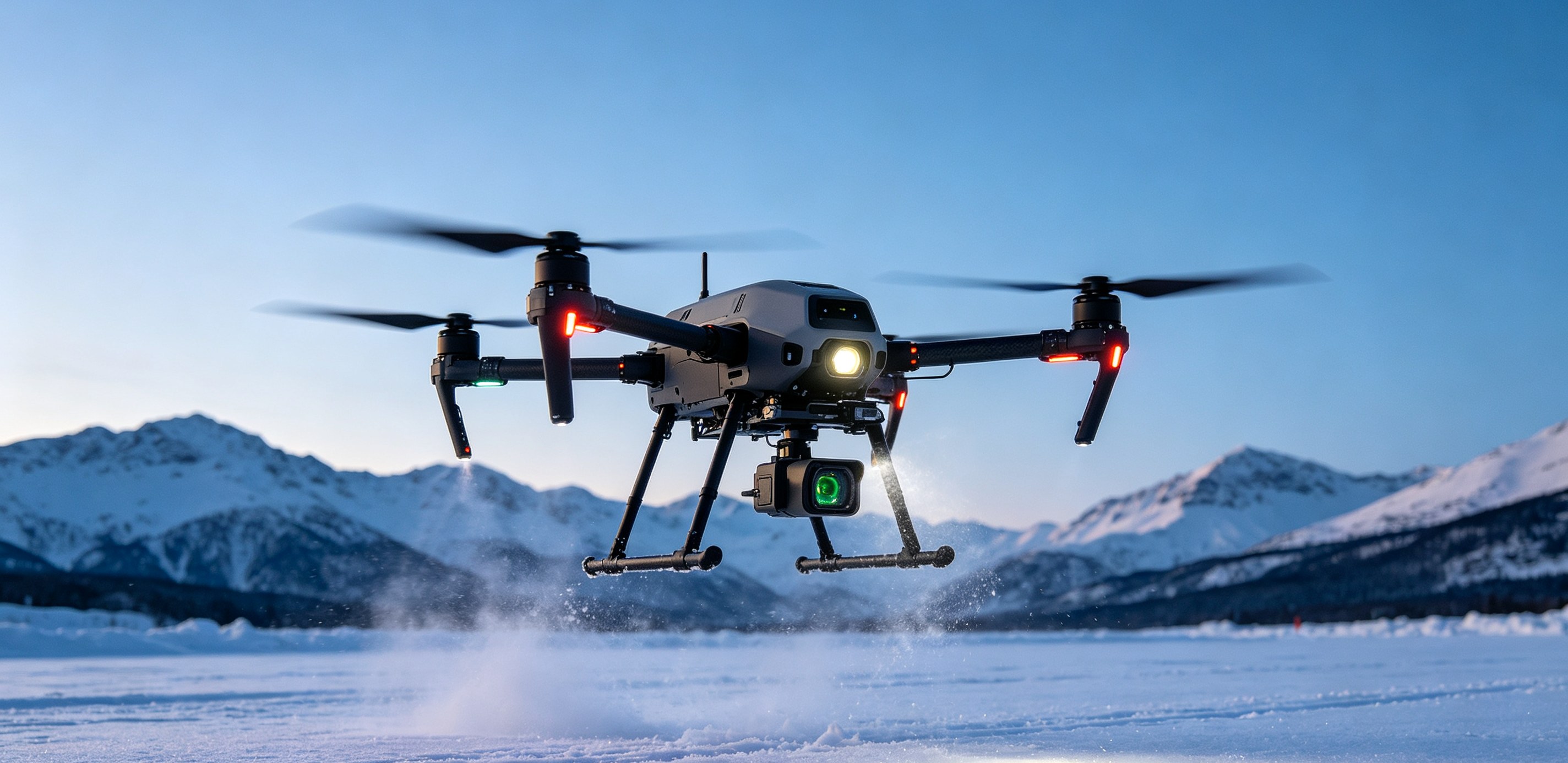
Winter flying brings more challenges than simply dealing with low temperatures. For UAVs operating in agriculture, surveying, logistics, and industrial inspection, cold weather can change battery discharge performance, motor operating conditions, and propeller loading.
A drone that performs reliably in summer may experience reduced thrust, shorter flight time, and slower power response in winter. These problems are not necessarily caused by the motor itself. Instead, they often result from changes across the entire propulsion system.
Understanding how low temperatures affect batteries, motors, and propellers helps UAV manufacturers prepare more reliable power systems for winter operations.
The battery is usually the first component to show noticeable performance changes in cold weather.
As temperature decreases, electrochemical reactions inside lithium batteries slow down and internal resistance increases. Under high-current discharge, this creates greater voltage sag, reducing the electrical power available to the propulsion system.
For UAV motors, the consequences are relatively straightforward:
Reduced Available Voltage: The battery voltage drops more significantly under load, limiting the voltage supplied to the ESC and motor.
Insufficient Thrust Response: When the available voltage and power decrease, the propulsion system may struggle to maintain the expected RPM and thrust under heavy loads.
Shorter Flight Time: Reduced usable battery capacity and increased voltage sag can trigger earlier low-battery warnings and shorten mission duration.
This explains why a drone may feel less responsive at the same throttle input during winter flights.
Battery preheating is therefore an important preparation step. However, the appropriate temperature depends on the battery manufacturer's specifications rather than a universal target.
Unlike batteries, electric motors do not respond to low temperatures in exactly the same way.
Two factors deserve particular attention: winding resistance and bearing lubrication.
Winding Resistance
Copper winding resistance decreases as temperature falls. This can slightly reduce copper losses under the same current.
However, this does not automatically improve overall propulsion performance. In real UAV operation, battery voltage sag and changes in mechanical resistance can have a much greater influence on available output.
When the battery cannot maintain its normal voltage under load, the motor may struggle to reach its expected operating speed, even though its winding resistance is lower.
Bearing Lubrication
Motor bearings face a different challenge.
At low temperatures, some bearing greases become more viscous, increasing starting friction and mechanical resistance. This is particularly noticeable when a motor has been exposed to cold conditions for an extended period.
During initial startup, increased bearing resistance may cause slower acceleration, higher initial current demand, or abnormal operating noise.
For UAV motor manufacturers, selecting suitable bearing specifications and low-temperature lubricants is important when developing motors for cold-weather applications.
A motor does not work independently. Its operating point depends heavily on the propeller, battery voltage, and aerodynamic conditions.
Cold air is denser than warm air at the same atmospheric pressure. This changes the aerodynamic load on the propeller.
At the same rotational speed, a propeller generally requires more torque and absorbs more power in denser air. Consequently, the motor may operate at a different current and RPM when using the same propeller.
At the same time, battery voltage sag can reduce the propulsion system's ability to maintain the required RPM.
These effects can work against each other:
Denser air changes propeller thrust and power demand.
Lower battery voltage reduces the available electrical power.
Increased mechanical friction can affect initial motor response.
The original motor-propeller operating point may shift.
This means summer motor and propeller test results should not automatically be treated as winter performance guarantees.
For OEM projects, engineers should evaluate motor KV, propeller diameter and pitch, battery voltage, ESC current limits, and expected operating temperature together.
Another winter risk is propeller icing. When flying through freezing fog, supercooled moisture, or other icing conditions, ice accumulation can change blade geometry and balance, increase aerodynamic drag, and cause abnormal vibration. This is a serious flight hazard, not simply an efficiency issue, and flights in unsupported icing conditions should be avoided.
Winter performance should be addressed through both pre-flight preparation and proper motor selection.
1. Keep Batteries Warm Before Takeoff
Store batteries in an insulated container and use an approved battery heater or preheating function when available. Bring the battery into the manufacturer's recommended operating temperature range before flight.
Avoid charging cold lithium batteries outside their specified charging temperature range.
2. Reserve Additional Thrust Margin
Do not select a motor based only on its summer maximum thrust. Consider the aircraft's total takeoff weight, payload, climbing requirements, and expected winter operating conditions.
A suitable thrust margin helps the propulsion system handle temporary load increases without continuously operating near its limits.
3. Recheck Motor and Propeller Matching
Review the propeller's diameter, pitch, and operating RPM under the expected winter conditions. Verify that motor current, ESC capacity, and battery voltage remain within their permitted limits.
4. Check Bearings Before Flight
After cold storage, inspect motor rotation for unusual resistance, noise, or vibration. Follow the motor manufacturer's recommended startup and inspection procedures rather than immediately applying high throttle.
5. Monitor Battery Voltage and Motor Temperature
During test flights, record battery voltage under load, motor current, RPM, and temperature. These measurements help identify whether reduced performance comes from battery voltage sag, mechanical resistance, or an unsuitable propulsion configuration.
For UAV OEMs, winter operation should be included in the propulsion system design rather than treated as an additional operating condition after development.
Several motor specifications deserve attention:
| Selection Factor | Why It Matters |
|---|---|
| Motor KV | Influences RPM and propeller matching |
| Continuous Current | Determines sustained electrical loading |
| Peak Current | Supports short-duration thrust demands |
| Bearing Specification | Influences starting friction and operating reliability |
| Motor Temperature Limits | Helps establish safe operating conditions |
| Propeller Compatibility | Determines actual thrust, torque, and power demand |
For agricultural drones, industrial UAVs, and heavy-lift platforms, these factors become particularly important because the aircraft may carry substantial payloads and operate for extended periods.
BGS Motor provides customized brushless motor solutions for different UAV configurations. By evaluating KV, propeller specifications, battery voltage, thrust requirements, and operating environments, the engineering team can help customers identify suitable motor configurations for their applications.
Winter UAV performance depends on more than motor power. Battery discharge capability, motor mechanical resistance, propeller loading, and operating conditions all influence the final propulsion performance.
A motor that delivers excellent thrust in warm conditions may operate differently when the battery voltage drops and the propulsion system faces a different aerodynamic and mechanical environment.
For UAV manufacturers, the most effective approach is to evaluate the complete propulsion system under realistic winter conditions, reserve sufficient performance margins, and verify motor-propeller compatibility before deployment.
Winter reliability starts with understanding how every component responds to cold, not simply choosing a more powerful motor.
 what's app